

2026.07.28 Patent
Practical Points on the Revision of the Examination Guidelines and Examination Handbook for Patents and Utility Models — Applicable to examinations conducted on or after July 1, 2026 —

On June 25, 2026, the Japan Patent Office (JPO) announced revisions to the Examination Guidelines for Patents and Utility Models and the Examination Handbook. The revised Guidelines apply to examinations conducted on or after July 1, 2026.
Please note that the revised Guidelines apply to all pending applications, regardless of their filing dates or examination request dates, and thus govern all future examination actions, including Notices of Reasons for Rejection and examination decisions.
In its responses to the public comments, the JPO emphasized that the revisions are intended merely to clarify existing examination practice, rather than to change it, and that examination practice should remain unchanged before and after the revisions.
The principal revisions are summarized below.
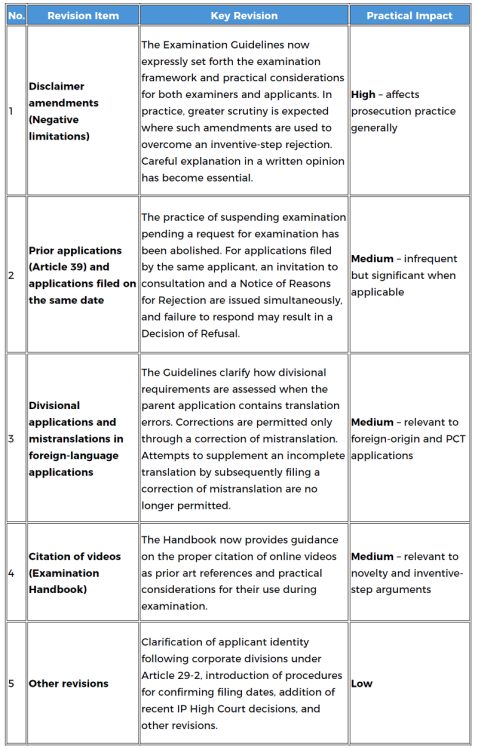
1.Disclaimer Amendments (Negative Limitations) (Most Significant Revision)
In response to the increasing use of disclaimer amendments and concerns expressed by third parties, the JPO has revised the relevant provisions of the Examination Guidelines concerning added matter (Article 17-2(3)), inventive step (Article 29(2)), and clarity (Article 36(6)(ii)).
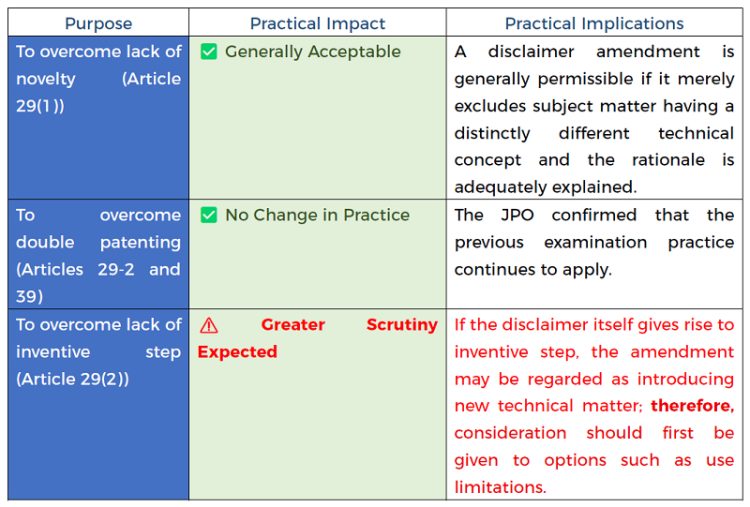
The revisions primarily address situations in which applicants seek to overcome a rejection for lack of inventive step by introducing a disclaimer amendment. As a practical matter, applicants who seek to overcome a rejection by means of such an amendment will now be expected to provide a well-reasoned explanation in a written opinion.
1-1.What Has Changed? (Added Matter: Examination Guidelines, Part IV, Chapter 2, Section 3.3.1(4))
・Clarification of the Examination Framework: Under the previous Guidelines, it was already provided that, like any other amendment, a disclaimer amendment is to be assessed based on whether it introduces new technical matter. However, because the previous Guidelines identified the following two traditional categories of disclaimer amendments:
(i) amendments that merely exclude the overlap with a cited invention; and
(ii) amendments excluding humans,
using definitive language, there was concern that these categories might be misunderstood as constituting the requirements for the allowability of disclaimer amendments. In other words, amendments falling within either category might be misunderstood as being automatically allowable, whereas amendments falling outside these categories might be misunderstood as being impermissible.
The revision expressly clarifies that categories (i) and (ii) are merely examples of disclaimer amendments that are normally allowable. It also clarifies that, even if a disclaimer amendment does not fall within either of these categories, it may be allowable in accordance with the principles set out in Section 3.3.1(2)(b), including amendments based on an explicit disclosure, matters immediately apparent to a person skilled in the art, or making a generic concept more specific. On the other hand, it is now expressly provided that a disclaimer amendment is not allowable if it adds a technical significance that could not have been understood by a person skilled in the art from the description, claims or drawings as originally filed.
・Clarification of Category (i): Category (i) has been redefined as follows:(i)
An amendment that merely excludes the overlap where the claimed invention coincidentally overlaps with a cited invention and therefore may lack novelty or otherwise fail to satisfy the patentability requirements, thereby clarifying that the claimed invention does not encompass inventions having a technical idea that is remarkably different.
The previous expression, “although the claimed invention inherently involves an inventive step,” has been deleted. The revised Guidelines also newly define an invention “having a markedly different technical idea” as an invention that a person skilled in the art would understand could never reasonably have been contemplated as being encompassed by the claimed invention at the time of filing, in light of the entire disclosure of the application as originally filed and the common general knowledge at the filing date.
Example 4 has also been replaced. The previous example involving a steel plate cleaning composition has been replaced with an example in which a toxic substance (sodium fluoroacetate) is excluded from a feed preservation composition.
・Newly Added Practical Considerations (The Most Significant Practical Change): The revised Guidelines introduce several important practical considerations.
First, where an applicant relies on Category (i), it is not sufficient merely to assert in a written opinion that the excluded subject matter represents a markedly different technical idea. Rather, the applicant is expected to explain, with reference to the disclosure of the application as originally filed, why the excluded subject matter could never reasonably have been contemplated in view of the technical problem addressed by the invention and the common general knowledge.
Second, where a disclaimer amendment is intended to overcome a rejection for lack of inventive step, the Guidelines expressly caution that the amendment may be regarded as introducing new technical matter if an invention that previously lacked an inventive step is transformed into one that is considered inventive solely as a result of the disclaimer.
Third, the Guidelines also remind applicants to consider the clarity requirement, particularly where:
the excluded subject matter constitutes a substantial portion of the claimed invention;
multiple exclusions are introduced;
the definition of the excluded subject matter is not found in the specification as originally filed; or
the definition used in the claim differs from that in the specification.
・Practice under Articles 39 and 29-2 Remains Unchanged: With respect to disclaimer amendments intended to overcome double-patenting (prior applications/enlarged prior applications) issues, the JPO explained in its responses to the public comments that “in many cases, such amendments merely exclude the overlap with an earlier application and therefore do not introduce new technical matter. Accordingly, where this is the case, the amendment remains allowable under the same principles as those set out in Section 3.3.1(2)(b) of the Examination Guidelines.”
1-2.What Has Changed? (Inventive Step: Examination Guidelines, Part III, Chapter 2, Section 2)
・The wording “eligibility as a cited invention” has been deleted from the revised Guidelines. The revised Guidelines expressly clarify that the mere existence of a factor that obstructs the reasoning does not, by itself, justify a finding of inventive step. Instead, inventive step is to be determined by comprehensively taking into account both positive and negative factors. The revised Guidelines also note that factors that obstruct the reasoning may differ in degree.
・With respect to evaluation of inventive step (logical reasoning), the revised Guidelines clarify that examiners should not place undue emphasis on the problem explicitly described in the cited document, but should also take into account problems that would have been readily apparent to a person skilled in the art, as well as problems that such a person could have readily conceived based on the common general knowledge at the time of filing after reviewing the cited invention. Consequently, arguments claiming that “there is a factor that obstructs the reasoning and thus inventive step exists simply because an essential element of the cited invention was removed” will become harder to sustain.
1-3.Examination Handbook (New Part XII, Chapter 1)
・Part XII, Chapter 1, “Examination of Applications Amended by Disclaimer Amendments” (12101-12103) has been newly added to the Examination Handbook. It sets out practical considerations for assessing inventive step, added matter, and compliance with the description requirements, together with four case examples.
The examples in which disclaimer amendments were accepted are:
“Condensed pyrimidine derivatives” (two specific compounds disclosed in the cited reference were excluded from a Markush claim → Decision to Grant a Patent); and
“Oral veterinary compositions” (sodium fluoroacetate, a toxic substance, was excluded → Decision to Grant a Patent).
The examples in which disclaimer amendments were not accepted are:
“Cleaning liquid for inkjet printers” (exclusion of the overlapping numerical range → New matter added + Lack of inventive step due to simple design change to a neighboring value); and
“Packaging bags” (exclusion of an essential element of the cited invention + Argument relying on a factor that obstructs the reasoning → The factor was considered insufficient to obstruct the reasoning, resulting in lack of inventive step, added matter, and lack of clarity).
In addition, Examples 32 and 33 relating to added matter in Appendix A (Case Examples) have been deleted.
・A practical way forward when applicants reach an impasse: If a disclaimer amendment is found to introduce added matter, an amendment deleting the disclaimer language (e.g., “excluding …”) may fall outside the permissible purposes of amendment under Article 17-2(5).
However, the revised Examination Handbook expressly clarifies that, where such a deletion is made together with an amendment restricting the claimed invention based on the matters described in the description, claims or drawings as originally filed, and it can be determined, by making effective use of the examination results already obtained, that no reasons for rejection remain, a Decision to Grant a Patent will be issued without dismissing the amendment (Section 12102).
Applicants may also present a proposed amendment during an interview or other opportunities to seek the examiner’s views. Furthermore, where a Decision of Refusal is issued, the reason for refusal based on added matter will be additionally stated for use as a reference in deciding whether to file an appeal.
1-4.EPractical Considerations
(1) A disclaimer amendment intended to overcome a lack of inventive step should be carefully considered. Applicants should first examine whether the objection can instead be overcome by a positive limitation, such as restricting the intended use or adding technical features. (The JPO also cautions that the excluded subject matter cannot be construed in light of the description, so the resulting scope of protection may not be as intended.)
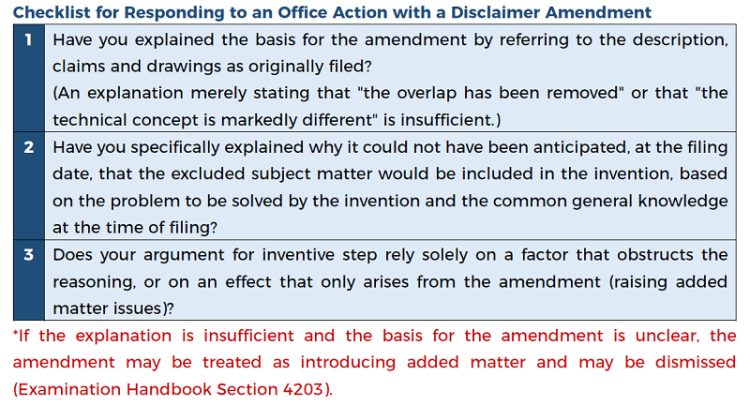
(2) Where responding with a disclaimer amendment, the written opinion should explain:
(a) how the basis for the amendment is supported by the description, claims and drawings as originally filed (an explanation merely stating that “the overlap has been removed” or that “the technical concept is markedly different” is insufficient); and
(b) why it could not have been anticipated, at the filing date, that the excluded subject matter would have been understood as falling within the technical concept of the invention, based on the problem to be solved by the invention and the common general knowledge at the filing date.
If these explanations are insufficient, the amendment may be regarded as introducing added matter and may be dismissed (Examination Handbook Section 4203).
(a) how the basis for the amendment is supported by the description, claims and drawings as originally filed (an explanation merely stating that “the overlap has been removed” or that “the technical concept is markedly different” is insufficient); and
(b) why it could not have been anticipated, at the filing date, that the excluded subject matter would have been understood as falling within the technical concept of the invention, based on the problem to be solved by the invention and the common general knowledge at the filing date.
If these explanations are insufficient, the amendment may be regarded as introducing added matter and may be dismissed (Examination Handbook Section 4203).
(3) Relying solely on a factor that obstructs the reasoning in arguing inventive step is risky. Applicants should also present other arguments, such as the absence of motivation or advantageous effects, and should avoid relying on effects that arise only as a result of the amendment, as this may result in the amendment being regarded as introducing added matter.
(4) The wording of the disclaimer should be unambiguous, and direct copying from the cited reference should be avoided. The wording defining the excluded subject matter should be consistent with the description as originally filed. In particular, disclaimer language that refers to another document—for example, “excluding compound A described in claim N of Japanese Patent Publication No. XXX”—should not be used, because it constitutes a violation of the clarity requirement if the scope of the exclusion cannot be determined without consulting that document. This point has been expressly clarified in the Examination Handbook (Section 12101).
(5) Disclaimer amendments intended to overcome a lack of novelty (Article 29(1)) or double patenting (Articles 39 and 29-2) may continue to be used as before. However, the explanations described in (2) above should likewise be provided with due care.
2. Changes to the Examination Practice for Conflicting Applications (Article 39) and Applications Filed on the Same Date
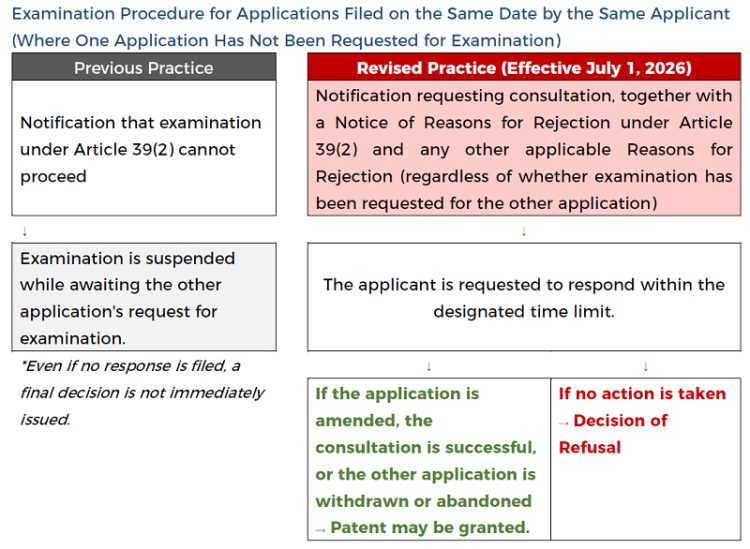
Situations in which multiple applications filed on the same date for the same invention give rise to issues under Article 39 are rare. However, the examination procedure applicable in such cases has changed significantly. Under the revised practice, the previous assumption that “examination will be suspended until the other applicant requests examination” no longer applies.
2-1.What Has Changed? (Examination Guidelines, Part III, Chapter 4)
・Applications filed on the same date by the same applicant (where both applications are pending): Under the previous practice, where examination had not been requested for one of the applications, the JPO issued a Notification that Examination under Article 39(2) Could Not Proceed, and examination was suspended. Under the revised practice, regardless of whether examination has been requested for the other application, the JPO issues an invitation to consultation together with a Notice of Reasons for Rejection under Article 39(2) (or Article 39(4), where applicable), as well as any other applicable Reasons for Refusal. If, within the designated time limit, neither the result of consultation is submitted nor any other response, such as an amendment, is filed, the consultations are deemed to have failed, and a Decision of Refusal is issued.
・Examination no longer stops even where the applications have different applicants: Even if examination has not been requested for the other same-date application, any Reasons for Refusal other than those under Article 39 are notified, and a Decision of Refusal is issued unless those reasons are overcome. Where no such Reasons for Refusal exist, the JPO issues an invitation to consultation without waiting for the other application to request examination, and the examination proceeds.
・New provisions regarding the submission of the result of consultation (Section 4.4.3): The revised Guidelines expressly clarify that applicants are not necessarily required to submit the result of consultation in response to an invitation to consultation. Instead, they may resolve the issue of identity between the inventions by filing an amendment or presenting arguments. Where the result of consultation is submitted, the applicant should specify, in a written opinion, written statement or similar document, the application designated by the consultations. If neither application contains such a statement, or if the statements in the two applications are inconsistent, the consultations are deemed to have failed. Furthermore, where only the other application is amended and no amendment is filed in the present application, if the examiner concludes that the two inventions remain identical after the amendment and there is no explanation that the present application is the application designated by the consultations, the present application is not presumed to be the application so designated, and the consultations are deemed to have failed.
・The revised Guidelines also expressly clarify that, even where the applications are filed by the same applicant, only the earliest application is entitled to a patent, reflecting the principle of one patent per invention. Other changes include a reorganization of the examination procedures for different scenarios and a simplification of the format and procedures for Article 39 notifications (Examination Handbook Sections 3405–3410).
2-2.Practical Considerations
・For pending applications filed on the same date that may claim the same invention (including parallel patent applications filed on the same date and a patent application filed on the same date as a utility model application), it is important to determine at an early stage which application should proceed to grant. Where the applications are filed by the same applicant, failure to respond within the designated time limit following the invitation to consultation and the Notice of Reasons for Refusal—whether by filing an amendment, submitting the result of consultation, withdrawing an application, or otherwise—may result in an immediate Decision of Refusal.
・Where the result of consultation is submitted, the statements submitted on behalf of the present application and the other application (whether in a written opinion, written statement or similar document) must be fully consistent. Inconsistent statements are treated as meaning that the consultations have failed. Even where only the other application is amended, it is important to explain, in the present application, why it should be regarded as the application designated by the consultations.
・Applicants should no longer assume that examination will not proceed until the other application requests examination. Under the revised practice, examination proceeds regardless of whether examination has been requested for the other application.
3. Divisional Applications and Mistranslations in Foreign-Language Applications (Also Affecting International Applications)
3-1.What Has Changed? (Examination Guidelines, Parts VII and VIII)
・Clarification of the criteria for divisional applications: Where the parent application is a foreign-language application, the revised Guidelines expressly clarify that Requirement 2 (remaining within the scope of the application as originally filed) is satisfied only if the divisional application remains within the scope of both the foreign-language application as originally filed and the translation as filed (including the scope within which translation corrections are permitted).
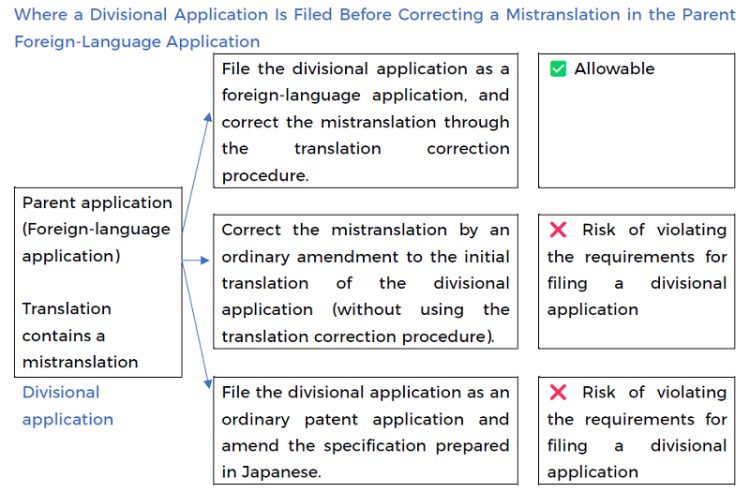
・Correction of mistranslations is recognized only through the translation correction procedure: Where the specification, claims or drawings of the parent application immediately before the filing of a divisional application contain a mistranslation, a correction made in the divisional application (filed as a foreign-language application) by submitting a translation correction statement is not regarded as violating Requirement 3 (remaining within the scope of the parent application immediately before the filing of the divisional application), provided that the correction falls within the scope in which a translation correction would have been allowable in the parent application. By contrast, no such relief is available where the mistranslation is corrected through the initial translation of the divisional application or by an ordinary amendment, rather than by a translation correction statement, or where the divisional application is filed as an ordinary patent application. In such cases, Requirement 3 is not satisfied, and the filing date of the parent application may not be accorded to the divisional application. In addition, correcting the mistranslation by an ordinary amendment may itself give rise to a Reason for Refusal based on new matter beyond the translation.
・Clarification regarding the period before submission of the translation: The revised Guidelines expressly clarify that, because no specification, claims or drawings exist for a foreign-language application until the translation is submitted, neither amendments nor divisional applications may be filed before that time.
・Prohibition against supplementing a partial translation through a translation correction statement (new Section 4.1.5): The revised Guidelines newly clarify that filing only a small portion of the foreign-language text as the initial translation and subsequently adding substantial portions of the translation by means of a translation correction statement constitutes an abuse of the system and is therefore not permitted. Any such additions are treated as new matter beyond the translation.
・The revised Guidelines also harmonize the examination practice for converted applications (converted from utility model or design applications), patent applications based on a utility model registration and international patent applications (Part VIII) with the above principles.
3-2.Practical Considerations
・When filing a divisional application based on a foreign-language application, applicants should avoid correcting a mistranslation in the parent application’s translation when preparing the translation or specification for the divisional application. Instead, the divisional application should also be filed as a foreign-language application, and the mistranslation should be corrected by submitting a translation correction statement. Filing the divisional application as an ordinary patent application, or correcting the mistranslation without using the translation correction procedure, does not qualify for the above relief.
・Where a divisional application is contemplated, it is advisable to review the translation of the parent application for possible mistranslations at an early stage. If a mistranslation is identified, applicants should determine before filing the divisional application whether a translation correction statement will be required.
・The translation must be submitted in its entirety within the prescribed time limit. A translation correction statement cannot be used as a means of adding omitted portions of the translation after the initial submission.
4. Citation of Online Videos (Examination Handbook)
4-1.What Has Changed?
The Examination Handbook has been updated to clarify the treatment of online videos and similar materials as cited references. The revisions include the addition of an example of how to cite a video in a Notice of Reasons for Refusal (Section 1207), as well as guidance on citing videos when determining whether an invention has been made available to the public through a telecommunications line (Section 3208, which incorporates and replaces former Section 3211).
The previous guidance stating that web pages requiring a password or payment may nevertheless be regarded as having been made available to the public (former Section 3208) has been removed as a separate section because its contents overlapped with Section 3209. However, there has been no substantive change in the JPO’s approach.
The revised Handbook also expressly clarifies that, even where the publication date is not shown on the webpage containing a video or similar material, the publication date may be established based on other evidence, such as the preservation date recorded by a web archive or information appearing on the “What’s New” page of the same website.
4-2.Practical Considerations
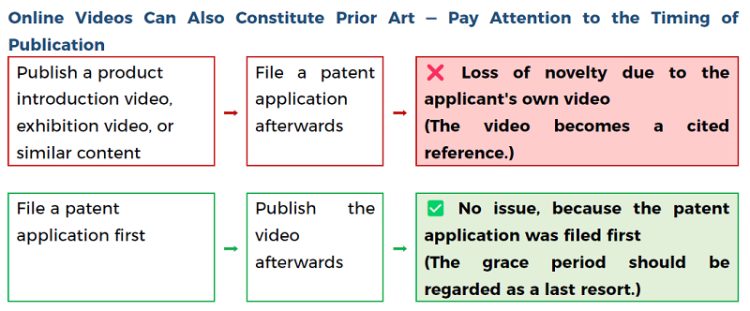
・It is expected that Notices of Reasons for Rejection citing online videos (such as YouTube videos) will become more common. Where a video is cited, applicants should carefully verify whether the publication date and time, the cited portion (identified by the playback time), and the examiner’s assessment of the disclosed content are appropriate.
・For those planning to file patent applications: Publishing product introduction videos, videos of exhibitions or presentations, crowdfunding videos, or similar materials before filing a patent application may destroy the novelty of the invention. Applicants should therefore ensure that a patent application is filed before any such video is made publicly available. If a video has already been published, prompt consideration should be given to whether the grace period under Article 30 is available.
5. Other Revisions
・Corporate Divisions and Identity of Applicants (Articles 29-2 and 39): With respect to determining whether the applicants are identical under Article 29-2, the revised Examination Guidelines expressly clarify (Part III, Chapter 3, Section 3.1.2, Note) that the JPO will also take into account a Notification of Change of Applicant. They further clarify that a change of name or a general succession (such as succession by inheritance, merger, or corporate division) takes effect even without notification to the JPO and that, accordingly, the applicants may be regarded as substantively identical even where the applicant names appearing in the records are different. The same approach now applies to determining whether applicants are identical under Article 39.
・Confirmation of the Filing Date or Filing Day of a Patent Application (new Part I, Chapter 2, Section 1): The revised Examination Guidelines newly clarify, as part of the examination procedure, that for divisional applications, converted applications, patent applications based on utility model registrations, and applications claiming the benefit of an earlier application by reference, the filing date (or filing day, where relevant) is confirmed only after it has been determined that the applicable substantive requirements are satisfied.
・Addition of an IP High Court Decision: Appendix D (Collection of Court and Appeal Decisions) has been updated to include a new decision relating to novelty and inventive step: Intellectual Property High Court judgment of September 29, 2025 (Case No. Reiwa 6 (Gyo-Ke) 10081), “Pet Animal Matching System and Pet Animal Matching Method.”
[Note]This article has been prepared based on the primary source materials published by the Japan Patent Office (JPO), including the revised Patent and Utility Model Examination Guidelines and Examination Handbook, the comparison table showing the proposed amendments, the principal changes made after the commencement of the public comment process, and the JPO’s responses to the public comments. This article is intended solely to provide general information and does not constitute legal advice with respect to any specific matter. When applying the revised examination practice to a particular case, readers are encouraged to consult the relevant provisions of the revised Examination Guidelines and Examination Handbook in their original form.
Edited by Kenshi Takenaka