

2026.09.01 Patent
Roles and Duties of Judicial Research Officials at the Intellectual Property High Court

This article is based on my article of the same title, “Roles and Duties of Judicial Research Officials at the Intellectual Property High Court,” contributed to PATENT, the journal of the Japan Patent Attorneys Association (PATENT 2026, Vol. 79).
1. Introduction
In recent years, as advanced technologies such as generative AI have developed, the utilization of intellectual property rights has advanced rapidly, and the role that the judiciary should play in protecting those rights has become ever more important. In Japan’s intellectual property litigation system, judicial research officials (hereinafter “research officials”) play an important role in assisting judges in their examination of cases by providing technical and specialized expertise.
In October 2022, the Intellectual Property High Court (hereinafter the “IP High Court”) moved from its courthouse in Kasumigaseki, Tokyo to a new courthouse in Nakameguro, Tokyo, entering a new phase as part of the “Business Court.” I served as a research official at the IP High Court for three years, from October 2022 to September 2025. The relocation to the Nakameguro courthouse took place shortly after I assumed the position, and although I was able to work at the Kasumigaseki courthouse for only about a week, being able to work at both courthouses proved to be a valuable experience.
This article explains in detail the roles and duties of research officials at the IP High Court—their statutory basis, staffing, and specific duties—and also introduces the working environment and collaborative relationships based on my practical experience. The objective description of the system is provided in Sections 2 through 5, while my personal impressions are set out in Section 6. The description of the system is based on the pamphlet published by the IP High Court in February 2025 and on related materials.
2. History of the IP High Court and the Relocation to the Business Court
2-1. Background to the Establishment of the IP High Court
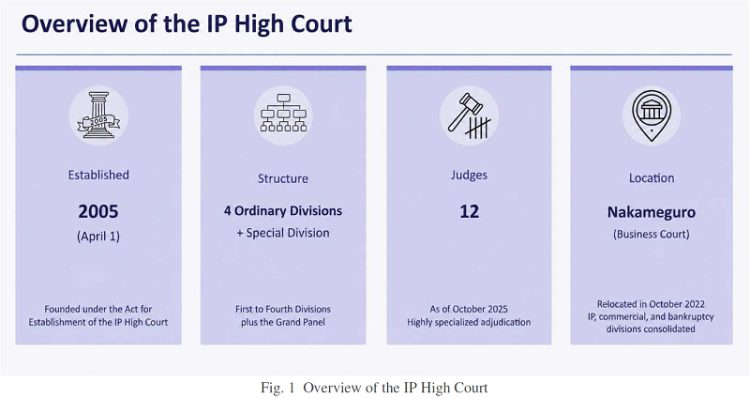
The IP High Court was established on April 1, 2005, as a special branch of the Tokyo High Court pursuant to the Act for Establishment of the Intellectual Property High Court. Its purpose was, in light of the increasing importance of the judiciary’s role in protecting intellectual property as the utilization of intellectual property advanced in Japan’s economy and society, to further strengthen the courts’ framework for handling specialized matters, thereby further enhancing and expediting the adjudication of intellectual property cases.
2-2. Organizational Structure of the IP High Court
The IP High Court comprises four ordinary divisions, the First through the Fourth Divisions, as well as a Special Division (the Grand Panel). Each ordinary division is a panel consisting of one presiding judge and two associate judges. The Chief Judge of the IP High Court concurrently serves as the presiding judge of the First Division, and the IP High Court as a whole is staffed by 12 judges (as of October 2025). The Special Division consists of five judges: the presiding judge of the First Division (the Chief Judge of the IP High Court), who presides over the panel; the presiding judges of the Second through Fourth Divisions; and the judge in charge of the case concerned.
2-3. The Relocation to the Nakameguro Courthouse
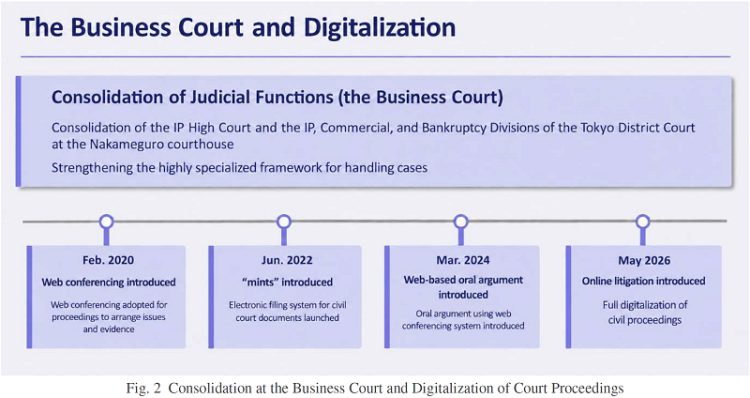
In October 2022, the IP High Court moved from its courthouse in Kasumigaseki, Tokyo, to a new courthouse in Nakameguro, Tokyo. There, it took on a new form as the “Business Court” together with the Intellectual Property Divisions of the Tokyo District Court and other related divisions (the Commercial Division and the Bankruptcy Division).
This move, which took place 17 and a half years after the establishment of the IP High Court, had the following three objectives.
(1) Consolidation of business-related litigation and procedures and enhancement of specialization
Consolidating the IP High Court, the Intellectual Property Divisions of the Tokyo District Court, the Commercial Division, and the Bankruptcy Division in a single courthouse put in place a framework for enhancing specialization in business-related litigation.
(2) Expedition of proceedings through the use of IT tools and other means
The new courthouse is equipped with state-of-the-art IT facilities, making it possible to conduct proceedings with active use of digital technologies such as web conferencing systems and electronic document filing systems.
(3) Promotion of international information dissemination and conduct of adjudication from a global perspective
The Business Court is also positioned as a hub for disseminating information in response to international intellectual property disputes. Each year the IP High Court holds the Judicial Symposium on Intellectual Property (JSIP), inviting legal professionals and others from overseas, disseminating information on Japan’s intellectual property justice system both at home and abroad, and providing up-to-date information on other countries.
While Kasumigaseki is located in Tokyo’s central government district, the new courthouse in Nakameguro stands along the Meguro River, in a scenic area lined with cherry trees that blossom in spring. The building has five floors above ground and one below; the IP High Court occupies the upper floors and has well-equipped courtroom facilities.
2-4. Promotion of Digitalization
The IP High Court is actively working to digitalize court proceedings.
In February 2020 the court began conducting proceedings to arrange issues and evidence using web conferencing; in June 2022 it introduced the electronic filing system for civil court documents (commonly known as “mints”); and in March 2024 it also began conducting oral argument using web conferencing. Furthermore, the Act Partially Amending the Code of Civil Procedure and Other Acts, enacted in May 2022, introduced provisions for conducting proceedings online from the filing of an action through to judgment (including the online submission of complaints and other documents, and the digitalization of case records). That Act came into force on May 21, 2026, and the IP High Court has been reviewing its litigation practice and improving the management of proceedings in response to its implementation.
As a result of this promotion of digitalization, new ways of working—such as the use of electronic materials—are also becoming established in the work of research officials.
3. Statutory Basis and Purpose of the Judicial Research Official System
3-1. Article 57 of the Court Act
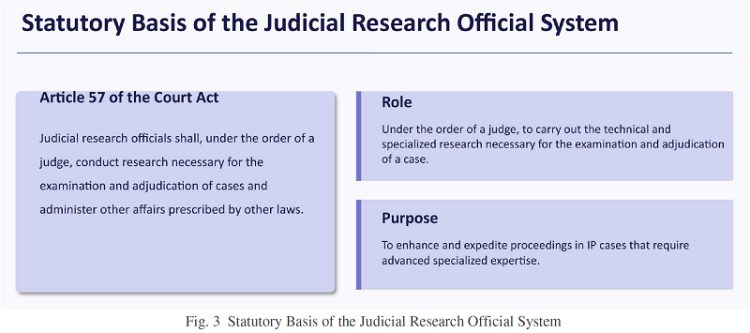
The statutory basis of the judicial research official system is Article 57 of the Court Act. Paragraph (1) of that Article provides that “judicial research officials shall be placed in the Supreme Court, in each High Court and in each District Court,” and paragraph (2) provides that “judicial research officials shall, under the order of a judge, conduct research necessary for the examination and adjudication of cases (in District Courts, limited to cases relating to intellectual property or taxation) and administer other affairs prescribed by other laws.”
Research officials in intellectual property matters are assigned in order to enhance and expedite the examination of cases requiring specialized and technical knowledge, and their significance is extremely high.
3-2. The Role of Research Officials at the IP High Court
The principal role of research officials at the IP High Court is to assist judges in their technical understanding by using specialized knowledge of the natural sciences and of the Patent Act and related laws.
For example, their roles include the following.
(i) Explaining the technology that forms the basis for understanding a case.
(ii) Providing supplementary explanations of the technical meaning of the parties’ arguments.
(iii) Assisting in the construction of reasoning that is sound from a technical standpoint.
3-3. The Principle of Party Presentation in the Courts and the Principle of Ex Officio Examination at the JPO
There is a significant difference in the fundamental principles governing litigation proceedings in the courts and trial and appeal proceedings at the Japan Patent Office (JPO).
Court litigation proceedings adopt the principle of party presentation. Under this principle, the collection and submission of the facts and evidence that form the basis of a judgment is entrusted to the parties’ authority and responsibility. A court may not base its judgment on facts that the parties have not asserted, and as a rule may not examine evidence ex officio that the parties have not offered. This rests on the view that, in disputes concerning rights and obligations between private persons, the intentions of the parties should be respected and the parties should be given the initiative in conducting the litigation.
By contrast, trial and appeal proceedings at the JPO adopt the principle of ex officio examination. Under this principle, administrative judges may investigate facts and collect evidence on their own authority. Administrative judges at the JPO are not bound by the parties’ assertions; they may search for prior art documents ex officio and may base their examination on evidence that the parties have not submitted. This rests on the view that industrial property rights such as patent rights are rights of a highly public nature that affect society as a whole, and that the discovery of the truth should therefore be emphasized in determining their validity.
In actions for rescission of JPO trial/appeal decisions, research officials assist judges on the basis of an understanding of the characteristics of both the trial and appeal proceedings at the JPO and the litigation proceedings in the courts.
3-4. Differences Between Judges and Research Officials
Judges and research officials both play important roles in intellectual property litigation, but there are clear differences in their nature and their roles.
Judges are generalists in the law. They are capable of handling cases in a wide variety of fields—civil, criminal, family law and other fields—not limited to intellectual property litigation. Their strengths lie in their highly developed skills in fact-finding and statutory interpretation, in their logical thinking, and in the broad perspective gained from handling cases in a variety of fields.
Research officials, by contrast, are specialists in technology and intellectual property law. They possess in-depth specialized knowledge of a particular technical field (mechanical, electrical, chemical and so on) and also have extensive practical experience with intellectual property legislation such as the Patent Act and the Utility Model Act. Their strengths lie in the depth of their understanding of technical matters, in their solid grasp of common general technical knowledge, and in the practical judgment developed through experience in patent examination and in trial and appeal practice at the JPO.
Judges and research officials thus each have different expertise and experience and play mutually complementary roles. The combination of the judges’ legal expertise and the research officials’ technical expertise enables the proper and prompt resolution of disputes in intellectual property litigation.
3-5. Scope of Cases in Which Research Officials Are Involved
As a rule, research officials at the IP High Court are involved in all technology-based intellectual property litigation, such as patent and utility model cases. They are involved most often in actions for rescission of JPO trial/appeal decisions, followed by appeals in patent infringement litigation. As a rule, they are not involved in non-technology-based litigation, such as trademark and copyright cases, but they may become involved where technical issues arise, as in cases involving copyright in computer programs.
4. Legal Status and Composition of Research Officials
4-1. Legal Status and Term of Office
Research officials are full-time court officials, and their legal status is as follows.
(1) Status
They are subject to the same laws as national public officials in the executive branch, including the National Public Service Act and the Act on Remuneration of Officials in the Regular Service.
(2) Term of office
There is no fixed term, although research officials normally serve for three years. Research officials are not all replaced at once but are replaced gradually, so that continuity and expertise are maintained.
(3) Prohibition on outside employment
During their term of office, they are prohibited, as national public officials, from engaging in outside employment.
4-2. Sources and Composition
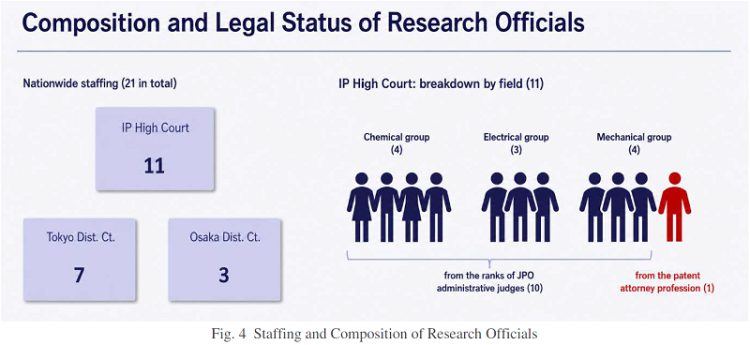
Research officials in intellectual property matters comprise ten drawn from the ranks of JPO administrative judges and one who comes from the patent attorney profession.
Research officials drawn from the ranks of JPO administrative judges resign from the JPO, serve in the courts, and, upon expiry of their term, are reappointed as administrative judges and return to the JPO. Their remuneration, working hours, leave, and similar matters are governed by the same laws that apply to national public officials in general.
Patent attorneys began serving as research officials at the Tokyo High Court and the IP High Court in April 2002, and at the Tokyo District Court in April 2003. Patent attorneys may be appointed without taking the national public service recruitment examination.
4-3. Patent Attorney Registration of Research Officials from the Patent Attorney Profession
When a patent attorney takes up a post as a research official, it is not necessary to cancel their registration as a patent attorney. Registration as a patent attorney is maintained during the term of office, but the person may not engage in patent attorney practice and must withdraw from representation in all cases. During the term of office as a research official, membership fees payable to the Japan Patent Attorneys Association are waived.
Patent attorneys are required to complete 70 credits of training over five years (one credit corresponds to one hour), but they are exempt from the credits corresponding to the period of service as a research official. Ethics training, however, must be taken even during the period of service as a research official.
4-4. Characteristics of Research Officials from the Patent Attorney Profession
Research officials drawn from the patent attorney profession have characteristics and experience that differ from those of research officials drawn from the ranks of JPO administrative judges.
Through their work representing clients in patent applications, patent attorneys have been deeply involved in the entire process from identifying inventions and drafting specifications to responding to examination and obtaining patent rights. In infringement litigation and in actions for rescission of JPO trial/appeal decisions, they have also been involved in devising litigation strategies and preparing briefs as representatives of client companies and inventors. For this reason, research officials from the patent attorney profession are characterized by readily understanding the perspective of patentees and their representatives—that is, “the perspective of the parties to the litigation.”
Research officials drawn from the ranks of JPO administrative judges, by contrast, have experience determining whether patentability requirements are met and drafting trial/appeal decisions as examiners and administrative judges. For this reason, they are well versed in the criteria used in making determinations in examination and in trial and appeal practice and in the logical structure of trial and appeal decisions, and are characterized by a “practical understanding of examination and trial and appeal practice.”
At the IP High Court, collaboration of research officials from the patent attorney profession with those drawn from the ranks of JPO administrative judges brings together the perspective of the parties to the litigation and the practical understanding of examination and trial and appeal practice, enabling more multifaceted consideration. In particular, research officials from the patent attorney profession find it easier to understand the background to and the intent behind the parties’ arguments in litigation, and are also adept at inferring the applicant’s intent when interpreting the statements in a specification. Research officials drawn from the ranks of JPO administrative judges, on the other hand, are adept at accurately grasping the logical structure of the JPO trial and appeal decisions and the criteria applied by the JPO for making determinations, and at clarifying the issues in actions for rescission of trial and appeal decisions.
In this way, collaboration among research officials with different backgrounds enhances the quality of their work at the IP High Court.
4-5. Staffing
There are only 21 research officials in intellectual property matters nationwide, making them rare even within the court system. Their allocation as of October 2025 is as follows.
IP High Court: 11 (4 in the mechanical field, 3 in the electrical field, and 4 in the chemical field)
Tokyo District Court: 7 (3 in the mechanical field, 2 in the electrical field, and 2 in the chemical field)
Osaka District Court: 3 (1 in the mechanical field, 1 in the electrical field, and 1 in the chemical field)
The IP High Court and the Tokyo District Court each have one research official from the patent attorney profession. At the IP High Court, the research official belongs to the mechanical group, while at the Tokyo District Court, the research official belongs to the chemical group. Because a research official normally serves for three years, there is only one opportunity for appointment every three years at each of the IP High Court and the Tokyo District Court, making opportunities for patent attorneys to become research officials extremely limited.
Research officials from the patent attorney profession are appointed through a selection process at the Japan Patent Attorneys Association and an interview at the Supreme Court.
(2) Term of office
There is no fixed term, although research officials normally serve for three years. Research officials are not all replaced at once but are replaced gradually, so that continuity and expertise are maintained.
(3) Prohibition on outside employment
During their term of office, they are prohibited, as national public officials, from engaging in outside employment.
4-2. Sources and Composition
Research officials in intellectual property matters comprise ten drawn from the ranks of JPO administrative judges and one who comes from the patent attorney profession.
Research officials drawn from the ranks of JPO administrative judges resign from the JPO, serve in the courts, and, upon expiry of their term, are reappointed as administrative judges and return to the JPO. Their remuneration, working hours, leave, and similar matters are governed by the same laws that apply to national public officials in general.
Patent attorneys began serving as research officials at the Tokyo High Court and the IP High Court in April 2002, and at the Tokyo District Court in April 2003. Patent attorneys may be appointed without taking the national public service recruitment examination.
4-3. Patent Attorney Registration of Research Officials from the Patent Attorney Profession
When a patent attorney takes up a post as a research official, it is not necessary to cancel their registration as a patent attorney. Registration as a patent attorney is maintained during the term of office, but the person may not engage in patent attorney practice and must withdraw from representation in all cases. During the term of office as a research official, membership fees payable to the Japan Patent Attorneys Association are waived.
Patent attorneys are required to complete 70 credits of training over five years (one credit corresponds to one hour), but they are exempt from the credits corresponding to the period of service as a research official. Ethics training, however, must be taken even during the period of service as a research official.
4-4. Characteristics of Research Officials from the Patent Attorney Profession
Research officials drawn from the patent attorney profession have characteristics and experience that differ from those of research officials drawn from the ranks of JPO administrative judges.
Through their work representing clients in patent applications, patent attorneys have been deeply involved in the entire process from identifying inventions and drafting specifications to responding to examination and obtaining patent rights. In infringement litigation and in actions for rescission of JPO trial/appeal decisions, they have also been involved in devising litigation strategies and preparing briefs as representatives of client companies and inventors. For this reason, research officials from the patent attorney profession are characterized by readily understanding the perspective of patentees and their representatives—that is, “the perspective of the parties to the litigation.”
Research officials drawn from the ranks of JPO administrative judges, by contrast, have experience determining whether patentability requirements are met and drafting trial/appeal decisions as examiners and administrative judges. For this reason, they are well versed in the criteria used in making determinations in examination and in trial and appeal practice and in the logical structure of trial and appeal decisions, and are characterized by a “practical understanding of examination and trial and appeal practice.”
At the IP High Court, collaboration of research officials from the patent attorney profession with those drawn from the ranks of JPO administrative judges brings together the perspective of the parties to the litigation and the practical understanding of examination and trial and appeal practice, enabling more multifaceted consideration. In particular, research officials from the patent attorney profession find it easier to understand the background to and the intent behind the parties’ arguments in litigation, and are also adept at inferring the applicant’s intent when interpreting the statements in a specification. Research officials drawn from the ranks of JPO administrative judges, on the other hand, are adept at accurately grasping the logical structure of the JPO trial and appeal decisions and the criteria applied by the JPO for making determinations, and at clarifying the issues in actions for rescission of trial and appeal decisions.
In this way, collaboration among research officials with different backgrounds enhances the quality of their work at the IP High Court.
4-5. Staffing
There are only 21 research officials in intellectual property matters nationwide, making them rare even within the court system. Their allocation as of October 2025 is as follows.
IP High Court: 11 (4 in the mechanical field, 3 in the electrical field, and 4 in the chemical field)
Tokyo District Court: 7 (3 in the mechanical field, 2 in the electrical field, and 2 in the chemical field)
Osaka District Court: 3 (1 in the mechanical field, 1 in the electrical field, and 1 in the chemical field)
The IP High Court and the Tokyo District Court each have one research official from the patent attorney profession. At the IP High Court, the research official belongs to the mechanical group, while at the Tokyo District Court, the research official belongs to the chemical group. Because a research official normally serves for three years, there is only one opportunity for appointment every three years at each of the IP High Court and the Tokyo District Court, making opportunities for patent attorneys to become research officials extremely limited.
Research officials from the patent attorney profession are appointed through a selection process at the Japan Patent Attorneys Association and an interview at the Supreme Court.
4-2. Sources and Composition
4-3. Patent Attorney Registration of Research Officials from the Patent Attorney Profession
4-4. Characteristics of Research Officials from the Patent Attorney Profession
4-5. Staffing
5. Specific Duties at the IP High Court
The duties of research officials at the IP High Court include a variety of tasks aimed at providing technical assistance to judges in their examination of cases. Those duties are described below in detail, focusing on actions for rescission of JPO trial and appeal decisions.
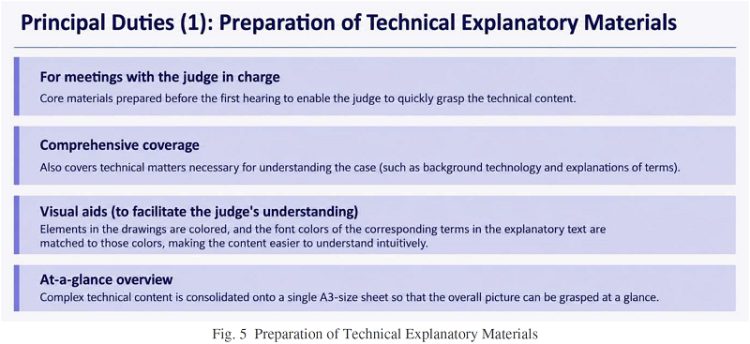
5-1. Preparation of Technical Explanatory Materials
When a case is assigned, the research official prepares technical explanatory materials for use in meetings with the judge in charge. These materials are often prepared in A3 size so that the content can be viewed at a glance. They include an overview of the invention at issue, an overview of the cited invention and a summary of the trial or appeal decision at issue, as well as explanations of the technical matters necessary for understanding the case. Various measures are taken to make the materials easy for judges to understand, such as adding color to the drawings and matching the font color of terms to the colors used in the drawings.
5-2. Attendance at Hearings
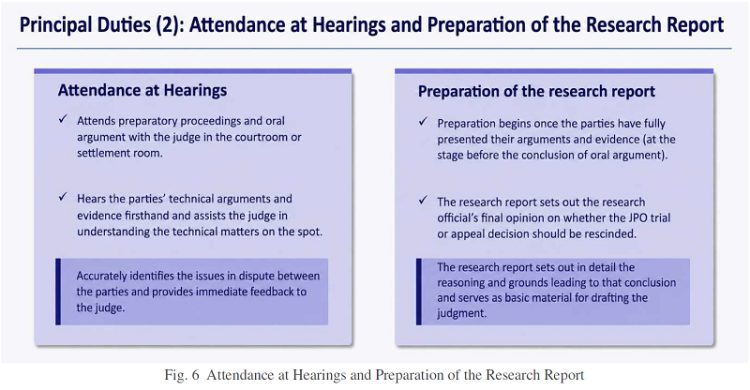
Research officials attend hearings, including preparatory proceedings for oral argument and oral argument. During preparatory proceedings, they sit next to the judge in charge; during oral argument, they usually sit in the public gallery of the courtroom. However, when a party is scheduled to provide a technical explanation during oral argument, they may take a seat on the bench.
5-3. Preparation of the Research Report
Once both parties have fully presented their arguments, the research official prepares a research report in accordance with the instructions of the judge in charge. The research report sets out the research official’s opinion as to whether the trial or appeal decision should be rescinded, together with the reasons for that opinion.
6. My Experience as a Research Official: Working Environment, Collaboration and Insights Gained
This section describes the working environment of research officials and their collaborative relationships with judges and other research officials, based on my experience serving as a research official at the IP High Court from October 2022 to September 2025. The discussion includes my personal impressions.
6-1. The Research Officials’ Office
At the IP High Court, 11 research officials work in the same office. The office provides ample workspace, with a desk for each research official as well as a table for meetings.
The atmosphere of the office is very calm and cooperative. While each research official concentrates on the cases assigned to them, the environment makes it easy to ask questions or seek advice as needed. Because research officials from different technical fields (mechanical, electrical and chemical) work in the same room, there are also opportunities to gain exposure to a broad range of specialized knowledge beyond their own technical fields.
Associate judges also came to the research officials’ office from time to time, and everyday conversation as well as case meetings helped create an environment that fostered close relationships between judges and research officials. This physically and psychologically open space supported smooth communication and collaboration.
6-2. Collaboration with Judges
The judges of the IP High Court are exceptionally capable and have a high level of understanding of technology. In case meetings, they listen attentively to the research official’s explanations and actively ask questions in order to deepen their technical understanding. While respecting the research official’s views, they also ask incisive questions from a legal standpoint, and I was able to learn a great deal through such discussions. Collaboration between judges and research officials enables cases to be examined in depth from both technical and legal perspectives.
6-3. Collaboration Among Research Officials
The research officials at the IP High Court comprise ten drawn from the ranks of JPO administrative judges and one from the patent attorney profession. Although each research official conducts research and reports individually on the cases assigned to them, they frequently seek other research officials’ views and hold discussions on cases that are technically difficult or that raise questions of legal interpretation.
As a research official from the patent attorney profession, I tended to view cases from the perspective of a party’s representative. However, through discussions with research officials drawn from the ranks of JPO administrative judges, I was able to learn the standpoint from which determinations are made in examination and in trial and appeal proceedings, as well as approaches to patentability requirements from a public-interest perspective. Conversely, my experience in drafting specifications and in litigation practice also appears to have been useful to other research officials, enabling me to build a mutually complementary collaborative relationship with them.
Such collaboration among research officials was extremely beneficial not only in deepening each research official’s knowledge and understanding but also in improving the quality of the overall work of research officials.
6-4. Interaction Outside of Cases
At the IP High Court, in addition to the examination of cases, meetings are held regularly for various committee activities and for preparations for the Judicial Symposium on Intellectual Property (JSIP), and research officials have many opportunities to interact with judges. In preparing for JSIP, judges and research officials work together on matters such as planning the program and communicating with overseas guests.
Through such interaction outside of cases, mutual understanding between judges and research officials deepens and everyday communication becomes smoother. I personally had the opportunity, through these activities, to interact more closely with many judges.
6-5. The Significance of the Research Official Experience and Hopes for the Future
Looking back on three years as a research official, I gained a great deal of knowledge and insight that would have been difficult to acquire in patent attorney practice. First, by observing at close hand judges’ thought processes and the process of drafting judgments, I greatly deepened my understanding of litigation practice. Second, through daily discussions with research officials drawn from the ranks of JPO administrative judges, I was able to learn the details of trial and appeal practice and the thinking underlying trial decisions. Third, I was able to observe on a daily basis how judges and other research officials—outstanding in both ability and character—approached their work, and to learn a great deal from their attitudes and methods. It was a valuable opportunity to learn firsthand what it means to work as a professional, including meticulous fact-finding, the structuring of logical reasoning, and the efficient performance of work within a limited time.
Moreover, the experience of playing a part in the administration of justice from within a public institution such as the courts added a new dimension to my career as a patent attorney. Considering that the judgments in the cases in which I was involved as a research official may serve as guidance for future intellectual property practice, I keenly felt both the weight of that responsibility and the great sense of fulfillment associated with it.
As noted above, opportunities for patent attorneys to serve as research officials are extremely limited—only one patent attorney is appointed every three years at each of the IP High Court and the Tokyo District Court. There is also the constraint that patent attorney practice must be completely suspended during the term of office, which may discourage patent attorneys from applying. In light of my experience, however, the knowledge and experience gained during those three years brought immeasurable value to my subsequent patent attorney practice.
As intellectual property litigation becomes ever more specialized, the importance of the collaborative relationship between the courts and the Japan Patent Attorneys Association is also increasing. For patent attorneys with enthusiasm and expertise to take on the challenge of serving as research officials contributes not only to their own career development but also to the enhancement of the intellectual property justice system as a whole. I hope that more patent attorneys will consider becoming research officials and will make the most of this valuable opportunity.
7. Conclusion
Research officials at the IP High Court, as specialists who assist judges on the basis of technical and specialized expertise, play an indispensable role in the proper and prompt resolution of disputes in intellectual property litigation. This article has provided an overview of the statutory basis of the research official system, the legal status and composition of research officials, and their specific duties.
The relocation to the Business Court in Nakameguro is a groundbreaking initiative that consolidates in one place the judicial functions relating to intellectual property litigation and enhances specialization and efficiency. The digitalization of litigation procedures, including the use of web conferencing systems, is also steadily progressing, contributing to collaboration with experts in remote locations and to greater convenience for the parties.
Looking ahead, as intellectual property disputes involving new technologies such as generative AI are expected to increase, research officials will be required to have even greater expertise and flexibility. It will be important to deepen collaboration with technical advisors while maintaining and enhancing expertise through continuous professional development. Continued consideration should also be given to institutional matters such as recruitment and training of research officials and the balance in the allocation of research officials among technical fields.
My own experience as a research official is as described in Section 6; I hope that this system will continue to function as a cornerstone of the intellectual property litigation system.
Edited by Kenshi Takenaka